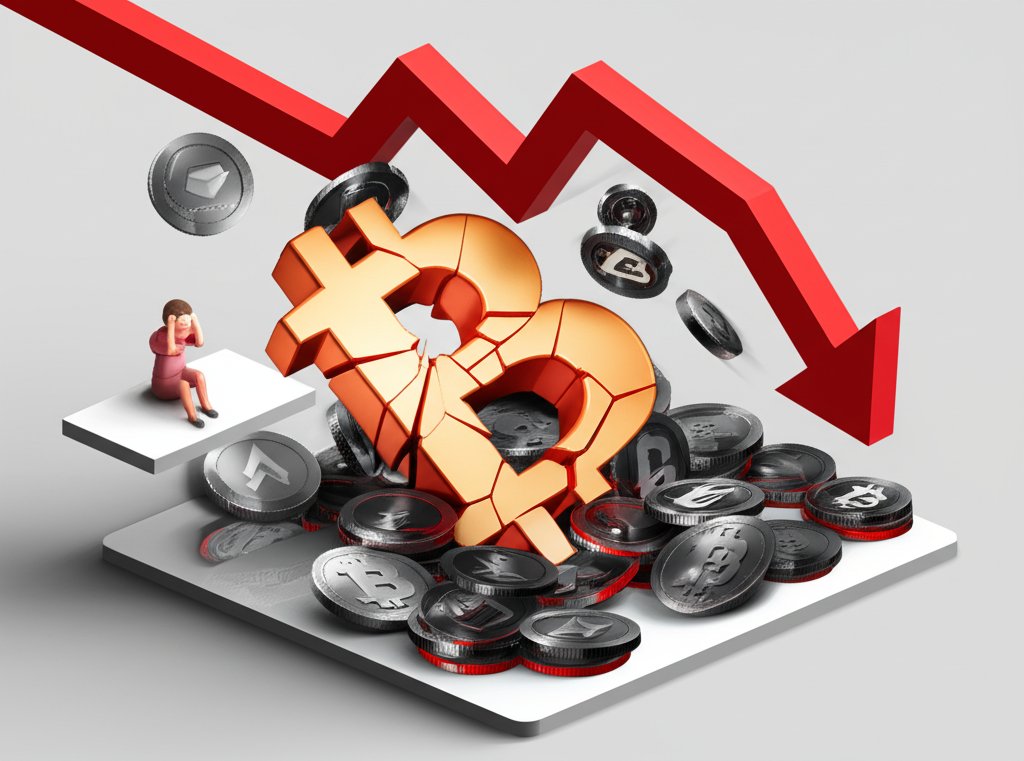
The recent performance of RED TOKEN, a prominent example within the broader category we often call "red crypto," serves as a stark reminder that even in a dynamic market, not all assets move in unison. While some cryptocurrencies might be experiencing an upswing, RED TOKEN has taken a significant dive, challenging optimistic market sentiments and prompting a closer look at what drives such a dramatic decline.
At a Glance
- Sharp Decline: RED TOKEN's value has plummeted by over 75% in a week, significantly underperforming the global crypto market and the Ethereum ecosystem.
- Critical Metrics Missing: Key financial health indicators like circulating market capitalization are unavailable, signaling potential transparency or liquidity challenges.
- Ultra-Low Volume: With minimal 24-hour trading volume, RED TOKEN faces extreme illiquidity, making price stability and exit strategies difficult.
- Project Context: Hailing from the "RED TOKEN ECONOMY" initiative, its ambitious goals haven't shielded it from severe market correction.
- Lessons for Investors: This scenario underscores the crucial importance of liquidity, comprehensive market data, and understanding fundamental project health beyond initial hype.
Decoding the RED TOKEN Plunge: What Happened Under the Hood?

The RED TOKEN ECONOMY, a joint venture by FIDA, Inc. and TOKYO ESPORTS GATE, Inc., launched with an ambitious vision: to build a global entertainment platform bridging the physical and digital realms from Tokyo. The RED TOKEN (RED) itself operates as an Ethereum-based cryptocurrency, positioning it within one of the blockchain world's most robust ecosystems. However, recent market data paints a challenging picture for this particular "red crypto."
According to CoinGecko, the RED TOKEN's performance has been anything but bullish. While it saw a marginal 24-hour gain of 0.03%, its seven-day performance reveals a devastating 75.60% drop. To put this in perspective, this decline dramatically underperforms the global crypto market, which saw a 9.00% dip, and stands in stark contrast to the Ethereum ecosystem's impressive 12.70% gain over the same period. This isn't just a minor blip; it's a significant decoupling from the broader market's movements. You can often see stark differences in individual token performance, even when you consider broader trends like those that can cause a general Red Coin's price jump explained across a category.
The trading activity itself further illuminates the dire situation. RED TOKEN is primarily traded on decentralized exchanges (DEXs) like DODO (Ethereum), where the WETH/RED pair recorded a paltry 24-hour trading volume of just $0.1065. This represents a staggering 99.80% decrease from the previous day's already low volume, indicating virtually no market activity. For context, its all-time high (ATH) was $0.886, while its all-time low (ATL) is very close to its current price of $0.064299, at $0.063214. The fully diluted valuation (FDV) is estimated at $42,910.72, assuming a maximum supply of 100 Billion tokens, yet critically, market capitalization data remains unavailable.
Beyond the Numbers: Unpacking the Decline's Core Factors

When a cryptocurrency like RED TOKEN experiences such a heavy plunge, it's rarely due to a single cause. Instead, a confluence of factors often amplifies negative pressure, making recovery challenging. For an expert evaluating this specific "red crypto," several key elements stand out:
The Illiquidity Trap: When Pennies Move Mountains
The most alarming data point for RED TOKEN is its minuscule 24-hour trading volume of $0.1065. This isn't just low; it's virtually non-existent. In practical terms, this means that very few buyers and sellers are willing to transact. When liquidity is this thin, even a tiny buy or sell order can drastically impact the token's price.
- Example Scenario: Imagine you want to sell 100 RED tokens. If the only available buyer is willing to purchase 50 tokens at $0.06 and the next buyer is only interested at $0.04, your small sell order could easily push the price down significantly. Conversely, a small buy order could artificially inflate the price momentarily, only for it to crash once that limited demand is met. For investors, this creates an almost impossible exit strategy without incurring substantial losses from slippage.
The Problem of Missing Market Capitalization Data
While we have an estimated fully diluted valuation (FDV) of $42,910.72 (based on a maximum supply of 100 Billion tokens), the crucial "market capitalization" figure is not available. Market capitalization is calculated by multiplying the current price by the circulating supply of tokens.
- Why it Matters: A missing market cap implies that either the circulating supply isn't publicly known or verifiable, or it's so small that exchanges aren't consistently tracking it. Without this figure, investors cannot accurately assess the project's true size, its ranking relative to peers, or its overall financial health. This lack of transparency is a significant red flag, making it challenging to gauge the token's actual value or potential for growth. An FDV alone, without context of circulating supply, can be highly misleading about a project's current standing.
Project Activity and Broader Market Disconnect
The RED TOKEN ECONOMY aims for a global entertainment platform. While the ambition is commendable, the token's current performance suggests a severe disconnect between its underlying utility (or perceived utility) and market demand. Even as the overall Ethereum ecosystem sees strong gains, RED TOKEN has moved in the opposite direction.
- What this Implies: This divergence suggests that factors specific to the RED TOKEN project are at play, rather than just general market sentiment. These could include a lack of recent development updates, insufficient adoption of the platform, competitive pressures, or simply a waning of investor interest following initial excitement. Without robust project milestones or demonstrable traction, even an innovative idea can struggle to maintain token value in a fickle crypto market.
Navigating Extreme Volatility: Lessons for "Red Crypto" Investors
The RED TOKEN's situation offers invaluable lessons for anyone engaging with early-stage or high-risk "red crypto" assets. It's a testament to the fact that even projects on established blockchains with ambitious goals can face severe headwinds.
The Allure and Risk of Ambitious Projects
RED TOKEN's objective to bridge physical and digital entertainment is compelling. Such narratives often attract early investors seeking exponential returns. However, the path from idea to mass adoption is fraught with challenges: technological hurdles, regulatory uncertainties, fierce competition, and the constant need for funding and community engagement.
- Practical Takeaway: Always scrutinize the execution roadmap and milestones. Is the team delivering? Are there tangible product launches or partnerships? A grand vision without consistent, verifiable progress is a significant risk indicator.
Liquidity: Your Exit Strategy's Best Friend
RED TOKEN's almost non-existent trading volume is a critical lesson in liquidity. For a crypto asset, liquidity is the ease with which it can be bought or sold without significantly affecting its price. High liquidity means many buyers and sellers, resulting in tight bid-ask spreads and stable prices.
- RED TOKEN's Reality: With $0.1065 in 24-hour volume, exiting a position of any meaningful size would likely trigger massive price drops. This effectively traps investors, as selling even a small amount could make the token worthless for subsequent sellers. Always check the 24-hour trading volume on multiple exchanges before investing. If it's consistently below a certain threshold (e.g., in the low thousands or hundreds of dollars), consider it extremely high risk.
The Misleading Nature of Fully Diluted Valuation (FDV) Alone
The FDV for RED TOKEN is estimated at over $42,000, assuming a theoretical max supply. While FDV gives a picture of a project's potential future value if all tokens were in circulation at the current price, it's often a poor indicator of current market health, especially when market cap is unavailable.
- Why be Cautious: Many projects have vast maximum supplies, making their FDV seem large even at a low price. But if only a tiny fraction of that supply is circulating or verifiable, the FDV provides little actionable insight. Focus on circulating market cap as a primary metric for current valuation and health. If it's missing, treat it as a significant gap in transparency.
Decentralized Exchanges (DEXs) and Volatility
RED TOKEN is traded on DODO (Ethereum), a decentralized exchange. While DEXs offer censorship resistance and direct peer-to-peer trading, they often have lower liquidity than centralized exchanges (CEXs) for smaller-cap assets. This lower liquidity on DEXs can exacerbate price swings.
- Investor Insight: While DEX trading is convenient, always be aware that trading smaller tokens on a less liquid DEX carries higher risk of price manipulation and difficulty in executing large orders without significant slippage. Check which exchanges list a token and their respective volumes.
A Practical Playbook for Evaluating High-Risk Cryptos
When you encounter "red crypto" projects, especially those exhibiting the volatile characteristics of RED TOKEN, a structured approach is essential. Here's a playbook to help you make more informed decisions and protect your capital.
Step 1: Prioritize Liquidity & Trading Volume
Before even considering a project's vision, look at its trading activity.
- Actionable Advice:
- Check 24-hour Trading Volume: Access CoinGecko or CoinMarketCap. If the volume is in the single or double digits (like RED TOKEN's $0.1065), consider it a critical warning sign. This indicates almost no active market.
- Examine Order Book Depth: On exchanges where it's listed, look at the order book. Are there many buy and sell orders at various price points, or are there huge gaps between bids and asks? Thin order books mean low liquidity.
- Question Exchanges: Is the token only listed on obscure or very small DEXs? Major listings often correlate with higher liquidity and vetting.
Step 2: Demand Full Market Capitalization Transparency
Don't settle for incomplete data. Market cap is fundamental.
- Actionable Advice:
- Verify Circulating Supply: Ensure the project openly shares its circulating token supply. If this figure is unclear, unverified, or constantly changing without explanation, proceed with extreme caution.
- Distinguish from FDV: Understand that FDV is a theoretical maximum. It doesn't reflect the current reality of the market. Prioritize circulating market cap for valuation. If market cap is missing entirely, it's a major red flag for assessing current value.
Step 3: Deep Dive into the Project's Fundamentals
The vision is important, but execution and adoption are paramount.
- Actionable Advice:
- Evaluate the Use Case: Does the RED TOKEN ECONOMY's entertainment platform have a clear, addressable market? What problem does it solve that existing solutions don't?
- Assess Team & Development: Research the core team's experience. Are they actively building? Check their GitHub, social media, and official announcements for consistent updates and progress. A stagnant project is a dying project.
- Community Engagement: Is there an active, engaged community? A strong community can signal long-term interest and support, even through tough times.
Step 4: Understand the Risks of Decentralized Exchanges (DEXs) for Smaller Assets
Trading on a DEX has specific implications.
- Actionable Advice:
- Slippage Awareness: When trading tokens with low liquidity on a DEX, always factor in potential slippage. This is the difference between your expected trade price and the actual execution price. Set slippage tolerance carefully.
- Security of DEXs: While generally secure, understand the smart contract risks associated with the specific DEX and token.
- Bridge to CEXs: Consider whether the token has a path to being listed on more liquid centralized exchanges, which could improve its market depth.
Case Snippet: The Illiquid Investment
An investor, let's call her Sarah, was excited by RED TOKEN ECONOMY's entertainment vision and its low price, hoping for a quick tenfold return. She invested $500. A week later, seeing the price plunge, she decided to cut her losses. When she went to sell, the DODO exchange's order book showed that to sell her entire holding, she'd have to accept a price 30% lower than the last recorded trade because there simply weren't enough buyers at higher prices. She executed the trade, realizing a significant loss not just from the price drop, but also from the lack of liquidity that forced her to sell well below market average. Her effective loss was far greater than the token's stated price decrease. This scenario highlights how illiquidity amplifies losses during a downturn.
Quick Answers to Common "Red Crypto" Questions
Q: Is a low token price always a good entry point for "red crypto"?
A: Absolutely not. A low price, especially for a "red crypto" like RED TOKEN with minuscule trading volume and a significant recent plunge, often indicates severe underlying issues. It can be a "falling knife" – dangerous to catch. Always pair price analysis with volume, market cap, and fundamental project health. A token at $0.0001 with robust fundamentals and high volume is a different proposition than a token at $0.06 with virtually no trading activity.
Q: What's the practical difference between a high Fully Diluted Valuation (FDV) and no market capitalization data?
A: FDV (Fully Diluted Valuation) represents the theoretical total value of a project if all its tokens (including those not yet in circulation) were liquid at the current price. It's often a future-looking or aspirational metric. Market capitalization, however, is the current real-world value of all circulating tokens. If market capitalization data is unavailable, it means we lack a key piece of information to assess the project's current size, stability, and liquidity. A high FDV with no market cap data suggests a potentially inflated theoretical value compared to actual, verified market activity.
Q: How can I add RED TOKEN to my MetaMask wallet?
A: To add RED TOKEN (on Ethereum) to your MetaMask wallet, you'll need its contract address. Go to MetaMask, click "Import tokens," select "Custom Token," and paste the contract address: 0xc744df3419a8c9bd4d6b9852a503eb1c5308a326. The token symbol (RED) and decimals (18) should auto-populate. Confirm, and the token will appear in your wallet.
Q: Does RED TOKEN's performance mean all "red crypto" is inherently risky or doomed to fail?
A: Not at all. "Red crypto" is a broad, informal term often referring to newer, smaller-cap, or potentially undervalued assets. The performance of one specific RED TOKEN highlights particular risks common in this space, such as illiquidity, lack of transparency, and failure to meet development milestones. Many "red crypto" projects can and do succeed. The key is applying stringent due diligence, understanding the specific risks of each project, and employing robust risk management strategies. RED TOKEN's plunge is a case study in what can go wrong, not a blanket indictment of an entire category.
Moving Forward: Decisions in a Volatile Market
The journey with RED TOKEN exemplifies the harsh realities of speculative crypto investing. For those who initially bought into its vision, the recent plunge is a painful lesson in market dynamics and the critical importance of foundational metrics.
When faced with a similar scenario, consider these decisions:
- Re-evaluate Your Thesis: Did your initial investment thesis hold up? Was it based on solid fundamentals, or hype?
- Assess Liquidity: Can you even exit your position without catastrophic slippage? If volume is near zero, your capital is effectively trapped.
- Monitor Project Activity: Is the team still active? Are there signs of recovery or renewed development, or has the project gone quiet?
- Cut Losses vs. HODL: This is a deeply personal decision, but for assets with such extreme illiquidity and performance deviation, "hopium" can be costly. Often, preserving capital is more important than waiting for an unlikely recovery.
Ultimately, RED TOKEN's performance serves as a potent reminder for all "red crypto" enthusiasts: conduct thorough research, prioritize liquidity and transparency, understand the true value of market capitalization, and never invest more than you can afford to lose. The crypto market rewards diligence and punishes complacency.